The Marriott Casa Monica Hotel FAIL…


Borepatch has the link and comments HERE…  


Honestly, I’m not surprised…


Marriott has never, in my opinion, treated the military well. I had an incident with Marriott a number of years ago while still on active duty, where I was given a room by the Marriott in San Diego that was adjacent to the elevator and the A/C was not operable (in the middle of the summer).  When I complained, I was told words to the effect of “What do you expect, you’re “military” and we can only charge you the per diem rate”.  And Marriott is notorious for changing their ‘military’ rates to exactly the per diem rate, even if they have quoted a lower rate on a reservation.


I’ll go to a $39.95 Indian run motel that stinks of curry and Vendaloo before I’ll take a free room at a Marriott…

Happy 236th Birthday Marines!!!


236 years, from the Halls of Montezuma to Helmand…


They continue to serve, continue to volunteer for the HARD jobs, and do them successfully. Can’t ask for more than that…


Semper Fi!

Alright already, you HAVE my attention…


Wanna know how to wake everybody up???


Put em in a concrete building, surround same with metal scaffolding…


And shake with a 6.8 earthquake…  THAT is a LOT of noise!!!


Needless to say, we departed the building rather quickly, but orderly…LOL


It appears the first quake at 1039L was a precursor quake, and fairly low level, but it rumbled long enough to notice.  The second one was an S-wave quake, magnitude 6.8 located 140 miles from us, on the bottom of the Pacific, and lasted probably 15-20 seconds!


We quickly grabbed what ever comms we had, and were checking the net, JTWC, and anybody else we could get hold of to see if we needed to head to higher ground, but that proved to not be required (thankfully)….


And went to lunch… 🙂

Ah… Warmth…


AND humidity (92% at 0530), and wind, and @@#^& rain… sigh…  


So I can either be wet, or dry and sweating; gotta love Okinawa…


Since my bag didn’t make the connection, I had to retrieve it yesterday, and finally get some clean clothes! I hate washing underwear and shirts in the tub, especially over here, because stuff NEVER gets dry.  There is a dehumidifier in the room, and I’m having to empty it twice a day (about a quart each time) just to try to break even on the humidity.


Flight over was ‘interesting’, ended up getting a last minute upgrade to business, and ended up sitting next to sumdood from Discovery Channel. He turned out to be a real ass, VERY liberal, anti-military and thought his ‘statements’ should be taken as gospel.  And he was driving the FAs nuts with his wine demands…


So I went to sleep rather that deal (e.g. short walk out the exit at altitude) with him…


We got to NRT a hour late, so by the time I got to the next airline desk, the airplane was already boarding, so jumped through hoops, and was literally the last person on the airplane (which IS better than being the first person NOT on the airplane)… Caught a ride up to the ‘hotel’ and finally got in the room at 2330, so roughly a 24 hour day.  And then too tired to sleep, so got about 3 hours and woke up at 0400 local…


This Friday will be Veterans Day, and as with the last couple of years, there will be people giving discounts to active duty and veterans.  If you are, or know a vet, please let them know about the specials, they can be found HERE.


In any case, take a moment to thank a Vet, or say a prayer for those still serving; because of them, we have the freedoms we enjoy today.   

NATIONWIDE EMERGENCY ALERT SYSTEM (EAS) TEST


Heads up- Read below and check it out so that there in no over-reaction…

NATIONWIDE EMERGENCY ALERT SYSTEM (EAS) TEST

On Wednesday, November 9, 2011, Federal Emergency Management Agency (FEMA), Department of Homeland Security (DHS), and Federal Communications Commission (FCC) will conduct the first national test of the Nationwide Emergency Alert System (EAS) test. This nationwide test will kick off at 2:00 p.m. (EST) and run concurrently across all time zones.

This system test is the first of its kind designed to broadcast a nationwide message to the American public. In the history of the country, nothing like it has been conducted on such a level. As you may be aware, there have been tests in the past, but not of this magnitude encompassing all regions of the Nation simultaneously. The three (3) minute test will run concurrently on all radio and TV band stations exceeding the previous messages broadcast which were anywhere from a 30 second to 1 minute message.

THERE IS GREAT CONCERN IN LOCAL POLICE AND EMERGENCY MANAGEMENT CIRCLES ABOUT UNDUE PUBLIC ANXIETY OVER THIS TEST. THE TEST MESSAGE ON TV MIGHT NOT INDICATE THAT IT IS JUST A TEST. FEAR IS THAT THE LACK OF AN EXPLANATION REGARDING THE MESSAGE MIGHT CREATE PANIC. PLEASE SHARE THIS INFORMATION WITH YOUR FAMILIES SO THEY ARE AWARE OF THE TEST.

Below is FEMAs website that will provide more information regarding this test:

Three Things…


We got into an interesting discussion over lunch today, and were trying to come up with three things in the next year that will occur outside the US, but still have a major impact ON the US…


And then the fight started… 🙂


When you have well educated, well read and well traveled folks, it gets interesting, to say the least!!!


And by consensus, I mean the other  ideas (and there were a bunch) got out voted…LOL


Edit- Wrote #1 in a hurry, left out important words… My bad… Now corrected. 


Consensus idea 1.  Israel ATTACKS (possibly nukes) Iran-  Forces re-evaluation of foreign policy and military drawdown; administration fails…


Consensus idea 2. Chavez/Castro/KI Jung die (one or all)- Russia (Putin) moves to secure control of governments, re-enforces communism. Alt 1 Raul Castro is prevented from taking power, Cuba ‘overthrows’ Castro regime, now what???


Consensus idea 3. Greece collapses taking the EU with it, Euro becomes worthless (effectively)-  Major hit to US economy, possible banking collapse(again), with no fallback.  UN effectively dismantled.


Only the first one is mine, the others came from some other folks (and my other two got voted off the island rather quickly)…


Comments? Are we right, wrong, stupid, full of it?  If you had to add ONE idea, what would it be?

NAPs, Again…


No, not THAT kind of naps…


These NAPs are Enlisted Naval Aviation Pilots…


The Navy, Marines and Coast Guard have a LONG tradition of Enlisted pilots dating back to 1916. HERE is the early history of the program.  I was lucky enough as a young enlisted to know the last Navy NAP, ACCM Bob (NAP) Jones, when I was stationed at GLYNCO.  I also met MGY/SGTs Robert M. Lurie and Patrick J. O’Neil when they flew down to GLYNCO to meet with ACCM Jones and ADCM “Pappy” Harbs who was my CMC.  Between them I think they had over 30,000 flight hours and had flown everything from props in and right after WWII to the latest jets… I remember Lurie’s favorite airplane was an F-8 Corsair, and I think he was one of the high time USMC pilots PERIOD in the F-8!


Why am I dredging up this old stuff???


Well, the program is back, yet again… This is at least the FOURTH evolution of Enlisted pilots, and this time it is for Drones!


I’m sure Everett over at Island Voice will chime in on this one, since he was in the first group to fly the DASHs off ships (and he has some stories about that!!!)


This was sent by a friend who was this Senior Chief’s CO in VC-6 back in the day when the SC was a young enlisted…


From CHINFO-


NAVAL AIR STATION PATUXENT RIVER, Md.- If the Navy starts training scores of enlisted to fly unmanned aircraft, they may want to thank a 37-year old Texan.

Senior Chief Aviation Electronics Technician (SW/AW) Stephen Diets is the only enlisted flying the MQ-8B Fire Scout, an unmanned helicopter. He’s a test case – part of a push from former Chief of Naval Operations Adm. Gary Roughead to determine whether a commission is necessary to succeed in naval aviation’s next chapter.


But Diets isn’t the first enlisted to fly an unmanned aerial vehicle. He and others have piloted the RQ-2A Pioneer, a small unmanned plane used for intelligence, surveillance and reconnaissance missions, which was in the fleet from 1986 to 2007.


As an external pilot, he was responsible for takeoffs and landings; it’s similar to flying a large remote-controlled airplane, he said.


His career began with the H-60 Seahawk, the fleet’s workhorse helicopter. Today, he’s the fleet liaison for the Fire Scout program and advises engineers on improvements and operations. But he’s also taking questions from Navy brass to help them decide whether enlisted should fly UAVs.


Diets won’t have any official say in the decision; he’s merely providing leaders with his perspective, expertise and feedback. He believes that enlisted will not only make good UAV operators, but the country’s fiscal constraints will make enlisted a more frugal choice to fly several types of unmanned systems.


Just Another Student


Before Diets took the Fire Scout’s controls, he completed a 21-day course at a civilian flight school where he trained on Cessnas and earned a private pilot’s license. After that, he and officer pilots from Air Test and Evaluation Squadron 1 completed a five-week Fire Scout course.


“They didn’t treat me any different, and that was something I asked for from the get-go. I’ll let them know if I’m having trouble with something, but don’t extend my course out,” he said.


He headed to the frigate McInerney in spring 2010, during the last month of the ship’s deployment for counter-narcotic operations in Latin America. It was the first time he would operate the Fire Scout at sea, and only one thing was on his mind.


“Don’t screw it up,” he said, laughing.


He flew the aircraft once or twice on that deployment and spent the rest of his time training Seahawk maintainers on repairing the Fire Scout and assuring it was safe for flight. He later deployed with the frigate Halyburton in January for its seven-month deployment in 5th and 6th Fleet, including operations near Libya. 

That time, he spent more time at the controls.


His work was identical to the work performed by officers – same missions, same procedures. They had a Northrop Grumman instructor on hand to help them with some of the UAV’s operations that they hadn’t fully mastered.


With two Fire Scout deployments under his belt, and countless hours working on the Fire Scout, Diets said enlisted are capable of operating that UAV and others.


“I think we’ve proven that enlisted guys can operate Fire Scout and I would go even further to say [the Unmanned Combat Air System] coming up and [the Broad Area Maritime Surveillance aircraft],” he said, respectively referring to a UAV that will take off and land on carriers, and the Navy’s version of the Global Hawk.


Officials at Naval Air Forces and Naval Air Systems Command did not answer a list of questions about their deliberations on allowing enlisted to operate UAVs. However, previous statements about Diets’ performance and the future of unmanned systems indicate that they’re largely supportive of enlisted operators at the controls.


“I think Senior Chief Diets demonstrated an ability to do it,” said Paul Achille, deputy program manager for the Fire Scout Program Office in an August interview.


Beyond Diets, it shows that more enlisted can do it, he said.


Rear Adm. William Shannon, the program executive officer for unmanned aviation and strike weapons, said “very, very capable enlisted Sailors” should eventually fly UAVs or he and others in his office have “absolutely failed in our jobs.”


Others, like Lawrence Schuette, director of innovation at the Office of Naval Research, said using enlisted is the only way to make unmanned systems affordable.


Creating A UAV Career Path


Diets said he thinks a new rating will be required for enlisted UAV operators, and those Sailors will be qualified to operate the Fire Scout as well as the broad-area maritime surveillance aircraft and the carrier-launched unmanned combat air system.


A common control system that uses identical toggles for several types of UAVs will help make this possible. He said he feels that operators should be at least a second-tour, senior E-5. His background with the Pioneer and H-60s made him a good fit to operate the Fire Scout, he said. He doesn’t recommend that future enlisted UAV operators go through the same training pipeline he completed. For one, his training process was compressed so he could be ready for a fast-approaching deployment. Also, enlisted operators will need supplemental training to make up for the tactical expertise their officer counterparts developed in the cockpit, he said.

Beyond training, Sailors need to have certain skills, he said. The biggest is the ability to mentally visualize three-dimensional spaces to create an imaginary map while flying unmanned aircraft.


“Anybody could do it as long as they could mentally separate all of those things out. And motivation. This ain’t easy. That last deployment was the most challenging deployment I’ve done in my 18 years,” he said.


Personally, I’m glad to see this, as it yet again proves that the Navy (and all the other services)  continue to get outstanding people who do an outstanding job!


Go Navy!!! 🙂

We’ve lost a friend…


William the Coroner passed away on Oct 30, for those who never had the pleasure of meeting him in person, he was big, bluff and quite a character; always pretty upbeat, even when he was having some physical problems, he loved teaching and shooting.  And loved upsetting the applecart by actually DEMONSTRATING weapons and their mechanisms of injury in his classes (but only on ballistics gelatin).   His obit is HERE.


Your humor and kindness will be missed my Friend, RIP William, RIP…


edit- AD , Crucis, Matt G, and  Laura that I know of, also have comments up…

Reality Check # 428…

Defense News has some detail on projected job losses in the Defense industry in the US and in our partner countries, and it’s NOT good…


This is the high side…

The AIA-sponsored report, released Oct. 25, was written by Stephen Fuller, who directs the Center for Regional Analysis at George Mason University in Virginia. For his calculations, Fuller used an input-output model and postulated that the congressional supercommittee would cut $1 trillion from the defense budget over a decade – $100 billion a year, of which $45.01 billion would be acquisition funding.
That would kill 352,000 defense jobs directly and some 650,000 more indirectly, he wrote. The cuts would siphon $59.4 billion out of the economy every year, docking national economic growth by 25 percent and adding 0.6 percent to the unemployment rate.
Fuller estimated that prime contractors would lose 164,000 full-time-equivalent jobs immediately, which would kill 108,000 jobs at first-tier suppliers and 80,000 more in the next tier. Those direct job losses would lead to almost twice as many indirect ones, he wrote.


And this is the LOW side…

Moreover, Garrett-Peltier said, Fuller nearly doubles the actual number of jobs that depend on the defense industry and overstates the “induced impacts” of job losses.
“For every one job, Fuller assumes 1.85 jobs – almost two additional jobs – are created,” she said.
Using a widely accepted model, Garrett-Peltier said, she found the inducted impact to be closer to 0.9 of a job.
Using Fuller’s assumptions but without the fourth level and a “more reasonable” induced impact number, Garrett-Peltier said she calculated job losses at about 520,000, roughly half the AIA’s estimate.
And she said it’s unlikely that the Pentagon will actually lose $100 billion a year.
“That’s a worst-case scenario,” she said.
Berteau, who said he had not done a detailed analysis of the AIA numbers, noted that the job losses would in any case be spread over a decade.
“This is not a million pink slips in one month,” he said.

While they may say that, most of the major defense contractors are already laying off people, at this point I ‘believe’ the totals are less than 100,000 jobs lost total across the contractors.


You can read the full article HERE.


Another point is that these are high tech/scientist/engineer/design teams type jobs, not line types…


Monday after the last shuttle landed there were 3000+ layoffs at NASA; how many more of our best and brightest scientists/engineers/etc. are we going to lose?  At least one former rocket scientist is currently working in a meat market in Texas…


If you don’t maintain the base, then when you DO have a need, the odds are it will not have an industry that will support it, e.g. steel production, of which most of the structural steel we see used in the US today comes from China…


There is also another report circulating written by an analyst at Booz , Allen, Hamilton that paints as gloomy a picture, and echos the above article.  It may come to the point that there are only 3 or 4 defense contractors left, and each one will have ONE area of ‘specialization’ e.g. air, surface, subs, Tanks/trucks, C4I, and no competition. If that happens, expect the administration to then start breaking these companies up under Anti-Trust laws (union or no union).


Before the question gets asked, I’ll answer why these companies can’t compete for ‘regular’ business…


It’s the overhead (specific accounting procedures/audits, security requirements, Information Assurance requirements, contract management requirements, etc.) and the people to support those ‘required’ government requirements that price most of these companies out of the ability to compete…  Most of the time the average worker’s overhead rates work out to about 145% of the labor rate, whereas a defense contractor’s overhead rate is seldom under 250% and usually higher.  Also most defense contractors are limited to 8% profit… 


So we’re counting on this “Super Congress” to save the Military, and somewhere between 1/2 million and 1 million high tech jobs just in defense…


I really doubt it… sigh…


And yes, it’s REALLY been a Monday all day, even if it is Halloween, this is a trick or treat I’d rather not have…

Range Time…

Youngest daughter is here for a couple of days, so I did what any good daddy does, I took her to the range 🙂


And took a bunch of different guns since she wanted to try different ones…


Pistols- Clockwise from top left; G17, G22, Ruger 22/45, C&S .45


Now the TRUE oddity, is my daughter actually liked shooting the G22 best, even though she was shooting full power loads through it… (weird kid)  All shooting was at 10 yards, so not too bad.  And the 22/45 is shooting a bit left, so I’m going to have to get the rear sight bumped over a bit…


Snubby- This was my Mother’s carry pistol for years… Colt Agent in .38


Daughter had a bit of a problem with head shots, so I told her to go to the bottom and shoot there (5 yards).  That’s a good old gun, but not an easy one to shoot, if you’ve never shot a snubby… 


SCAR 17…

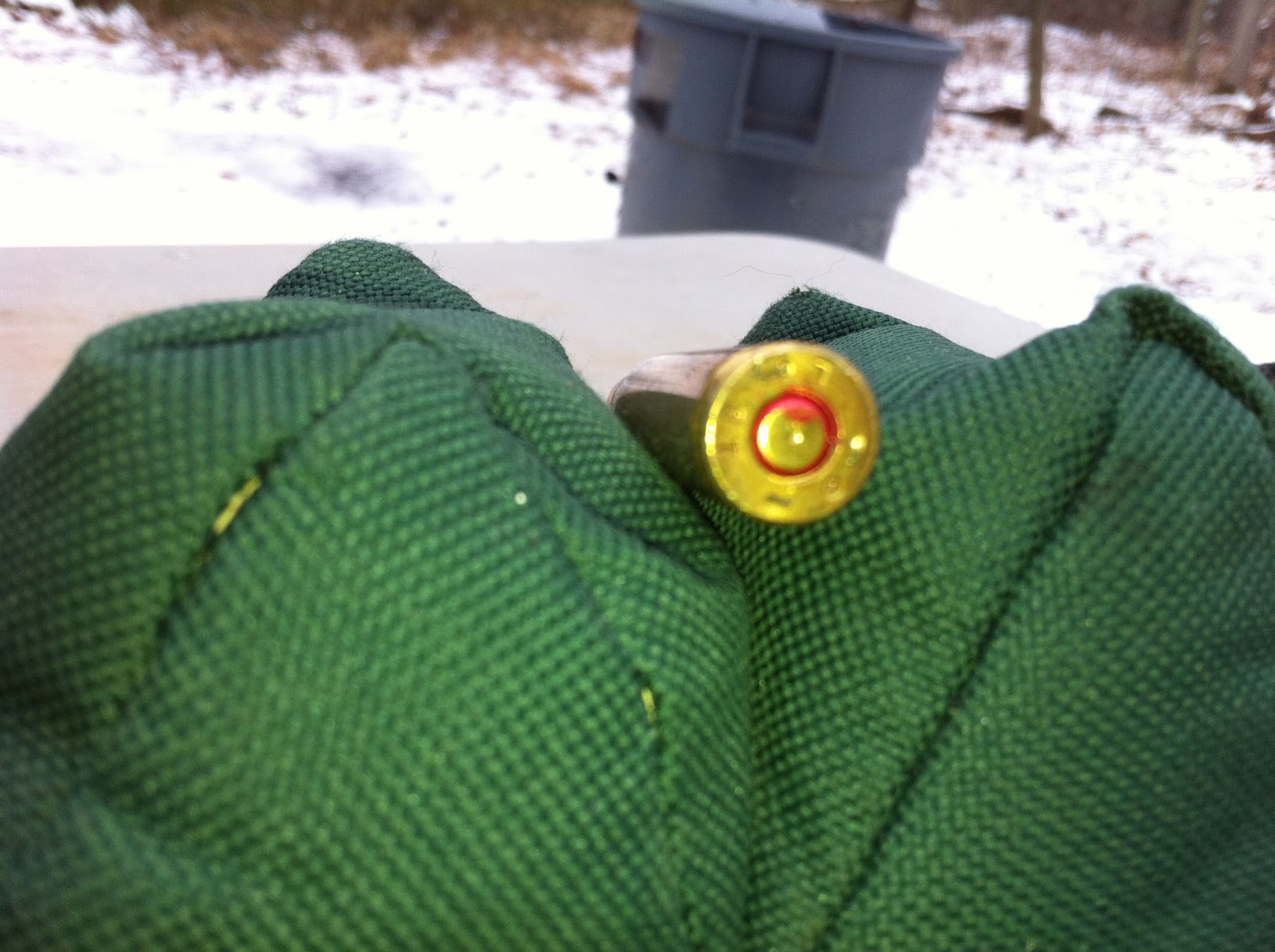
And she wanted to shoot the ‘big’ gun (she’s 5’2″ about 120lbs), so I put three in a group and let her shoot the rest.  She didn’t do badly for never having shot it, and the table being a bit high for her (like she had to stand and lean over to shoot it)…


And for ONCE, I got some help cleaning guns, so it’s all good 🙂  


Oh yeah, and it was snowing earlier…